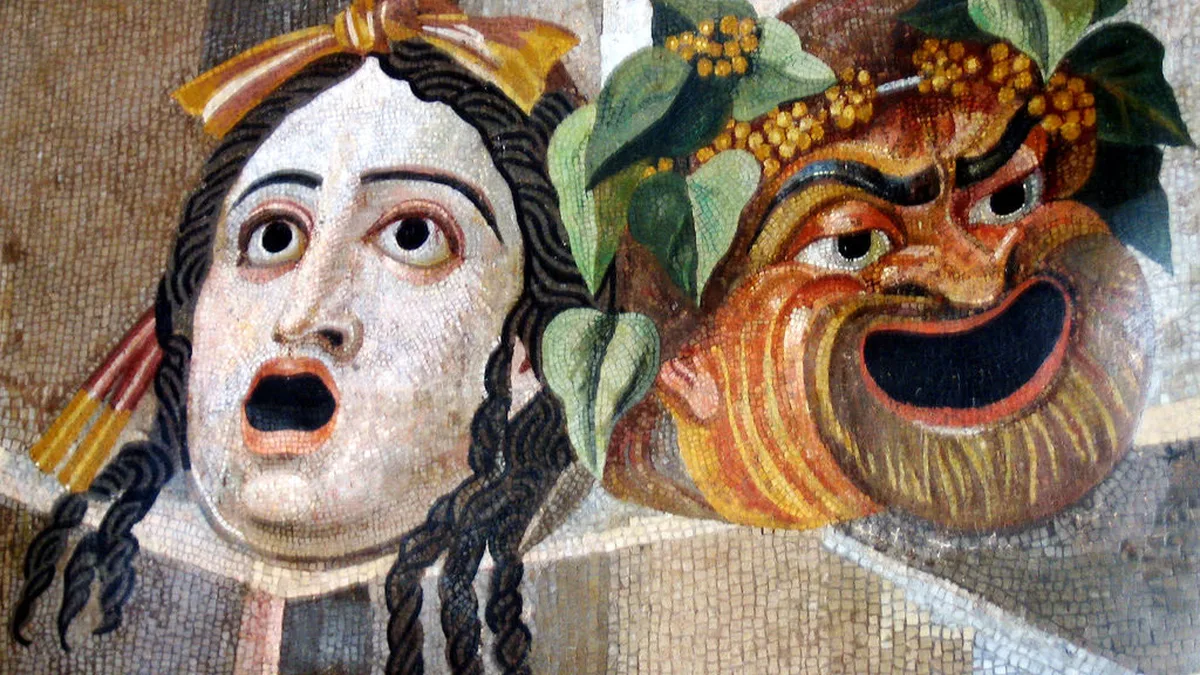
Comedy
| Country of origin | Greece |
|---|---|
| First created | 5th century BCE |
| Original use | Public performance in Athenian theatre competitions |
| Mediums | Stand-up, sitcom, film, sketch, improv |
| Core technique | Setup and punchline, incongruity, exaggeration |
| Audience interaction | High (direct address, crowd work) |
| Notable subgenres | Satire, slapstick, parody, dark comedy |
| Typical venues | Comedy clubs, theaters, television, streaming services |
Origin and history
Comedy as a formalized performance tradition has ancient and geographically diverse origins. Its earliest documented forms arise from theatrical competitions in ancient Greece during the 5th century BCE, where it served as a counterpoint to tragedy. In Asia, comedic elements were integral to Sanskrit drama in India and to early Chinese theater forms such as Zaju from the Song dynasty. The European Middle Ages saw comedy preserved and evolved through traveling performers, minstrels, and within folk festival traditions. The commedia dell'arte troupes of Renaissance Italy, starting in the 16th century, established influential character archetypes and improvisational structures. These multiple, parallel developments demonstrate that comedy is a fundamental and widespread human cultural expression, not invented in a single time or place.
What it is for
Comedy serves the primary function of provoking laughter and amusement through incongruity, surprise, exaggeration, or the recognition of familiar human failings. It functions as a social corrective by using satire and ridicule to critique authority, societal norms, and hypocrisy, often making difficult truths more palatable. Comedy provides psychological relief by allowing an audience to release tension and anxiety through laughter, a process historically described as a "safety valve." It fosters social cohesion by creating shared experiences and in-group bonding through common references and humor. The form is also used for educational purposes, utilizing humor to enhance memory and engagement with complex subjects. Furthermore, comedy exists as a pure artistic pursuit, valuing aesthetic innovation, timing, and the skilled craftsmanship of joke-telling and performance for their own sake.
Overview
Comedy encompasses a vast array of genres and delivery formats, each with distinct conventions and techniques. Stand-up comedy features a solo performer delivering a direct address to an audience, typically revolving around observational humor, personal anecdote, and crafted punchlines. Sketch comedy presents short, scripted scenes performed by a ensemble cast, often parodying specific situations or media formats. Improvisational comedy is created spontaneously based on audience suggestions, relying on collaborative principles and quick wit. Sitcoms (situation comedies) are narrative television or radio series centered on a fixed set of characters in recurring environments, using humor derived from interpersonal dynamics. Satire uses irony, sarcasm, and exaggeration to expose and criticize folly or vice, particularly in politics and society. Additional forms include slapstick (physical humor), dark comedy (finding humor in grave subjects), parody (imitation for comic effect), and comedic drama, which blends humorous and serious elements.
What to know
Successful comedy relies on precise timing, rhythm, and the performer's ability to read and manage the audience's reactions, known as "riding the laugh." The fundamental mechanism of most humor is the "incongruity theory," where a surprising or logical mismatch between a setup and a punchline creates a comedic effect. Context is paramount, as material that is hilarious in one cultural, temporal, or social setting may fail completely or cause offense in another. The line between edgy humor and causing genuine harm is a persistent ethical debate within the field, concerning the targets and social impact of jokes. Legal considerations, such as copyright law regarding joke theft and defamation, are serious professional concerns for comedians. Understanding the distinction between subjective taste (what an individual finds funny) and objective craft (the technical skill present in the work) is crucial for critical analysis of comedy.
Common questions
A common question is whether comedians can or should joke about absolutely anything, which leads to ongoing debates about free speech, audience responsibility, and the potential to reinforce harmful stereotypes. People often ask how comedians deal with hecklers, which involves a set of practiced techniques ranging from witty comebacks to involving security, all aimed at regaining control of the room. Many wonder how much of a stand-up special is truly spontaneous, though specials are typically highly rehearsed performances of polished material that mimic a casual flow. A frequent inquiry concerns the difference between satire and mere offense, where satire is defined by its clear critical intent and identifiable target, whereas offense may be a byproduct of shock without coherent point. Audiences commonly question how writers generate material, a process that usually involves constant observation, journaling, and rigorous workshoping of jokes in small clubs. Finally, people ask if comedy is becoming more difficult, referencing shifting social sensitivities and the permanence of digital recordings, which alters the traditional ephemeral nature of live performance.
Pros and cons
A significant pro of comedy is its unique capacity to build immediate rapport and break down social barriers, creating a sense of shared community and understanding. It provides a powerful vehicle for social and political commentary, able to distill complex issues into accessible and memorable critiques that can bypass audience defenses. For the practitioner, mastering comedy can lead to profound creative satisfaction, intellectual challenge, and the tangible reward of direct audience feedback. A major con is the inherent instability and subjectivity of the form, where success is notoriously unpredictable and material can fail based on subtle shifts in audience mood or delivery. The field often demands significant personal sacrifice, including irregular hours, extensive travel, and the psychological toll of frequent rejection and public criticism. A common mistake is conflating shock value with substance, leading performers to rely on offensive language or topics as a crutch instead of developing stronger writing and observational skills, which can limit their artistic growth and audience reach.
Who it suits
Comedy suits individuals with a high tolerance for risk and rejection, as the path is fraught with public failure and requires resilience to persistently refine material. It is well-suited to acute observers of human behavior, social norms, and linguistic nuance, who can identify and articulate the inherent absurdities in everyday life. The field demands strong verbal intelligence, quick mental processing, and often a degree of performative courage to command attention and navigate live, unscripted interactions. It appeals to those who think non-linearly and can make unexpected connections between seemingly unrelated concepts, a key skill in crafting original humor. Comedy is a natural fit for people who wish to engage with societal issues indirectly, using persuasion and entertainment rather than direct confrontation or lecturing. Finally, it suits collaborators, especially in sketch and improv, who thrive on ensemble dynamics and the principle of supporting fellow performers to build a scene collectively.
Latest Comedy news
Latest reporting

The Choir reunites James Corden and Ruth Jones for Apple TV
James Corden and Ruth Jones reunite for their first project since the Gavin & Stacey finale in a new comedy-drama, The Choir, premiering on Apple TV...

Scottish 1926 film Till the Bells Ring predates The Jazz Singer
A 46-minute Scottish domestic comedy with synchronised sound, premiered in Edinburgh in October 1926, is now recognised as the world's first talking...